Software Engineer Salary: Netherlands vs Germany vs UK, Take-Home Compared
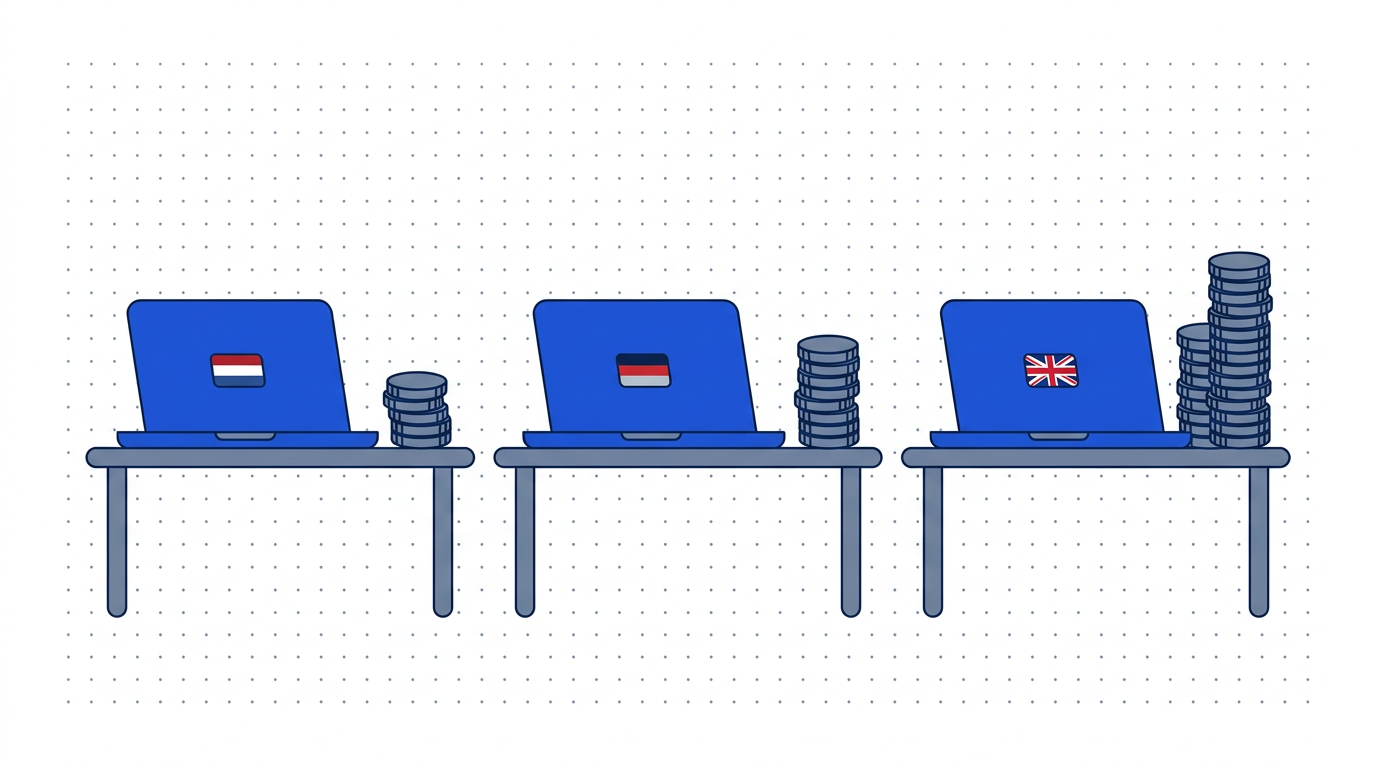
A software engineer comparing offers in Amsterdam, Berlin, and London usually starts with the gross number, since that's what's printed on the job ad. Glassdoor's data puts the median software engineer salary at €70,500 in the Netherlands, €75,000 in Germany, and £55,900 in the UK, which at a glance makes Germany look like the best-paid of the three. Run all three through the actual tax brackets, social contributions, and credits each country applies, and the ranking by what actually lands in a bank account looks nothing like the ranking by what's printed on the offer letter.
The gross numbers, and why they're already hard to compare
These figures come from Glassdoor-reported salary data for the 'Software Engineer' title specifically, not a general tech-sector average. A junior engineer starts around €53,200 in the Netherlands, €62,000 in Germany, and £40,600 in the UK. At the senior end the three converge far more closely: €115,500 in the Netherlands, €116,000 in Germany, and £116,400 in the UK, three numbers that look nearly identical on paper despite being two different currencies.
That near-identical senior figure is exactly why gross salary alone is a poor way to compare these three markets. Once €116,000 and £116,400 get taxed under three completely different systems, the size of the number on the offer letter stops mattering nearly as much as the structure sitting underneath it.
What the median salary actually nets out to
Run the median figure for each country through the real 2026 brackets and the picture changes immediately. The Netherlands' €70,500 nets to €49,295 a year, a take-home rate of 69.9%. Germany's higher €75,000 nets to just €37,556, a take-home rate of 50.1%. The UK's lower £55,900 nets to £42,979, a take-home rate of 76.9%, the best of the three by a wide margin.
Converted to a monthly figure, the country with the highest advertised salary, Germany, actually pays its median software engineer the least take-home pay of the three in absolute monthly terms: €3,130 a month, against €4,108 in the Netherlands and the UK's £3,582. The gap between Germany's gross and the Netherlands' gross all but disappears once tax is applied, then reverses.
Why Germany loses despite the higher salary
Germany's combination is genuinely the harshest of the three at this income level: a progressive income tax already climbing toward its higher bands well before €75,000, plus four separate social contributions, pension, health, unemployment, and long-term care insurance, stacking up to 20.4% of gross on their own. At €75,000, the income tax bill is also large enough to trigger the solidarity surcharge, which only applies once the tax bill itself passes €20,350. €75,000 clears that easily, while the more junior €62,000 salary doesn't, which is part of why junior German engineers keep noticeably more (53.6%) than median ones (50.1%) relative to how close those two gross figures actually are.
None of this is unique to software engineering, it's the same four-layer contribution stack that puts Germany near the bottom of most take-home comparisons. It just shows up more starkly here because the profession's gross salary happens to be the highest of the three countries, which makes the tax system's bite look even more dramatic by comparison.

The UK's lighter National Insurance does a lot of the work
The UK keeps the highest share of gross pay at every level shown here, junior, median, and senior alike, and the reason is structural rather than a special break for engineers. National Insurance charges 8% on a wide band of earnings and 2% above it, nowhere near the layered social contribution systems in continental Europe. Income tax itself isn't soft, 40% kicks in above £50,270, but with a much lighter contribution layer next to it, the total deduction ends up lower at every income level tested here.
It's worth flagging that the UK's £116,400 senior figure sits close to the income band where the personal allowance starts tapering away above £100,000, so a UK senior engineer's actual take-home rate can drop faster than the headline 45% top rate suggests once a bonus pushes total pay further into that band.

The Netherlands sits in between, helped by two credits Germany doesn't have
The Dutch loonheffing brackets look steep on paper, 35.75% from the first euro, climbing to 49.5% above €78,426, numbers that read worse than Germany's progressive bands at a glance. What closes the gap is the algemene heffingskorting and arbeidskorting, two tax credits that come straight off the income tax bill rather than off taxable income, and both are still largely intact at a €70,500 salary. That's a big part of why a Dutch engineer on a lower gross salary than their German counterpart still takes home over €1,000 more a month.
The gap looks different again at the senior level, where both Dutch credits have mostly phased out: at €115,500 the Dutch take-home rate drops to 60.2%, behind the UK's 67.1% but still comfortably ahead of Germany's 49.6%, since Germany's four-contribution stack doesn't ease up at higher pay the way the Dutch credit-driven gap does.
Figures use each country's own currency at a near-identical senior gross figure, so the percentage gap reflects the tax system, not a currency effect.
What this means if you're choosing between two offers
A recruiter quoting a bigger number in euros or pounds isn't necessarily quoting a bigger paycheck. If you're weighing a Berlin offer against an Amsterdam or London one, the Germany figure needs to be meaningfully higher, not just a little higher, to actually net out ahead once the four social contributions and the solidarity surcharge are accounted for.
The cleanest way to check is to run your specific offer, not the median figure here, through the calculator for that country, since real offers rarely land exactly on the median, and a few thousand either way can shift which side of a bracket or credit phase-out threshold you land on.
The takeaway
None of this means Germany is a bad place for a software engineer to work. There's a public pension, statutory health insurance, and long-term care cover sitting behind those contributions, things an engineer in the UK or Netherlands has to fund separately or rely on a thinner state system for. But if the comparison is specifically about what lands in your account each month, the gross salary printed on the job ad is the least reliable number to compare across these three countries, and in this specific match-up, it's actively misleading.
Frequently Asked Questions
Why does Germany pay software engineers more but they take home less?
Germany's median gross salary (€75,000) is the highest of the three, but a four-part social contribution stack (pension, health, unemployment, long-term care) plus a progressive income tax that triggers the solidarity surcharge above a €20,350 tax bill combine to take 49.9% of it, leaving a lower net salary than the Netherlands' lower gross figure.
Can I directly compare the UK figures in pounds to the euro figures?
Not as absolute amounts, since GBP and EUR aren't the same currency. The take-home percentage (what share of gross you keep) is comparable across currencies, but converting the actual pound or euro amount you'd have in hand requires applying a live exchange rate on top of these figures.
Do these figures include pension contributions or stock options?
No. These are standard employee income tax and mandatory social security figures only. Workplace pension contributions, employer-matched savings schemes, equity, and other benefits vary by employer and aren't included in either the gross salary data or the net calculations.
Where do these salary figures come from?
Glassdoor-reported salary data for the 'Software Engineer' title in each country, the same figures used in MyPayCalc's profession pages. Actual offers vary by company, seniority, and specialisation, so treat these as a reference point, not a guarantee.